The JavaScript's For...of loop structure is syntactic caster sugar dusted over the good old for statement. It's an extremely capable loop that can iterate almost anything you give it.
Basically, for...of iterates over the values of an array, not keys.
A bit of looping history
During the neolithic era we had to loop like this:
var testArray = [2, 3, 5, 7, 11]
for (var i = 0; i < testArray.length; i++) {
  console.log(testArray[i])
  // Outputs: 235711
}
Then ES5 gave us the forEach, and an access to the array value without any
intermediate steps:
testArray.forEach(function (value) {
  console.log(value)
  // Outputs: 235711
})
That feels pretty good (read more about forEach
here). But, you
can't break, and you can't straight up iterate a nodelist with forEach.
Then, finally, ES6 brought us the for...of loop, which liberates us from,
pretty much, all the looping limitations.
The for...of loop
Iterate an array
var testArray = [2, 3, 5, 7, 11]
for (var value of testArray) {
  console.log(value)

  if (value > 5) {
    break // Can break
  }
}
Iterate a string
For...of can also iterate a string:
var name = 'Slartibartfast'
for (var letter of name) {
  console.log(letter + '.')
  // S.l.a.r.t.i.b.a.r.t.f.a.s.t
}
Loop over a NodeList
Finally this is doable without for loop and without any forEach
shenanigans:
var listItems = document.querySelectorAll('ul > li')

for (var item of listItems) {
  item.classList.add('hello')
}
Speed
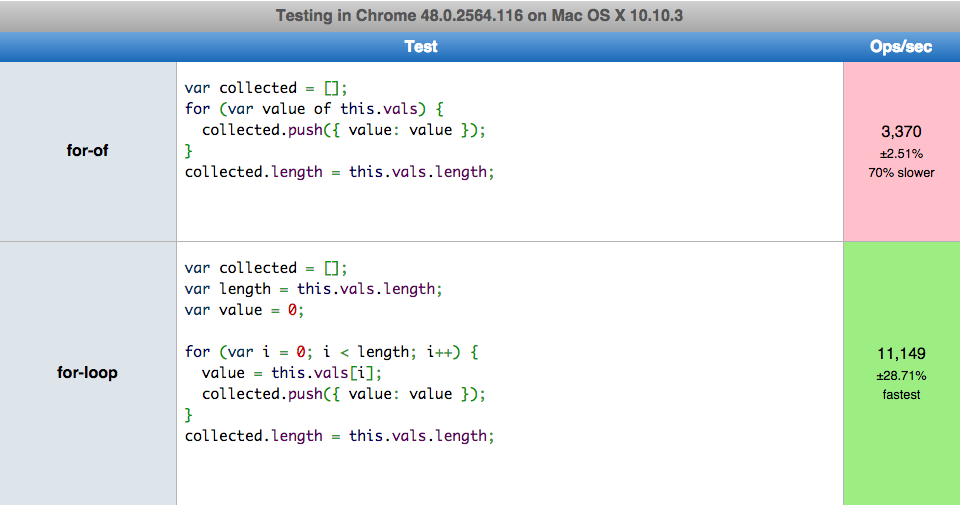
for...of seems to be slower than for, but that's okay.
Here's the test I used.
Conclusions
for...each can loop over almost anything you throw at it: Maps, Sets,
Generators, you name it. Read more about in
MDN.